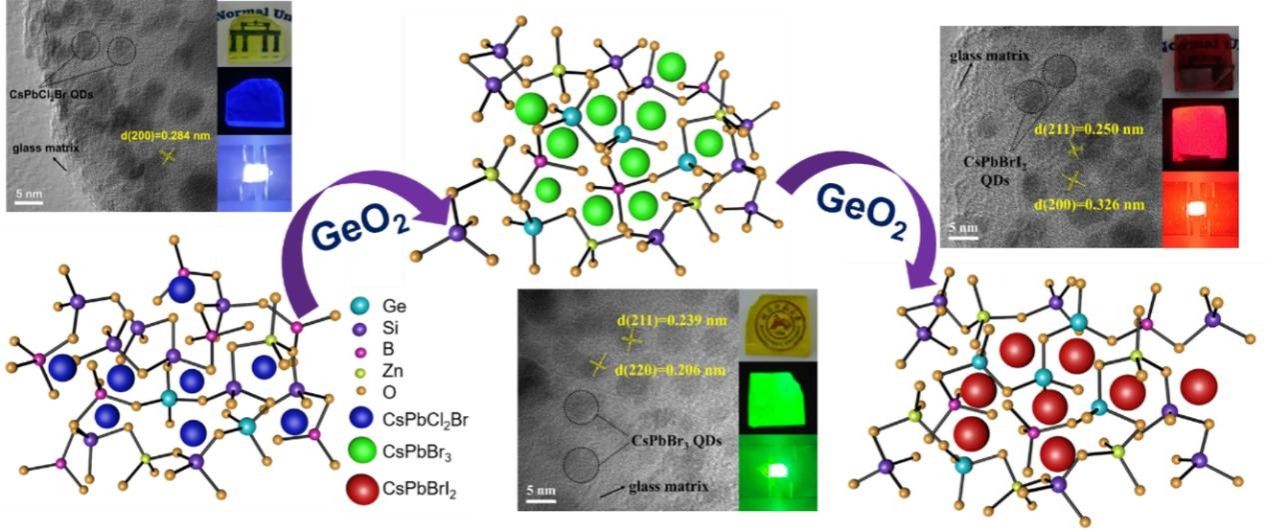
近日,研究生沈帅龙在Chemical Engineering Journal 发表题为“Regulating the local glass networks to enhance the optical performance of CsPbX3 (X = Cl, Br, I) quantum dots embedded in zinc borosilicate glasses via GeO2”的研究论文,通讯作者为余丽萍教授。
论文摘要:All inorganic CsPbX3 (X = Cl, Br, I) perovskite quantum dots (QDs) have excellent optical properties, and show great potential in optoelectronic devices, information storage, wide color gamut backlight display and other fields. In previous work, embedding CsPbBr3 QDs into glass matrix through in-situ crystallization has become an important strategy to improve the stability of quantum dots. However, few reports have been made on the synthesis of high-quality whole family CsPbX3 QDs glass by melt-quenching method. Herein, CsPbX3 QDs glasses with full visible spectrum were synthesized by a closed melt-quenching technique. And the precise content of GeO2 was used to regulate the size of glass network gaps to accommodate different sizes of CsPbX3 QDs. The deconvoluted infrared spectra confirmed that the introduction of GeO2 was beneficial to the increase of non-bridging oxygen in the rigid structure, the number and percentage of [BO3] triangular units increased correspondingly, and the glass network changed in a three-dimensional and looser benign way, which was beneficial to the growth of large-size QDs. Finally, the luminescent properties of CsPbCl2Br, CsPbBr3 and CsPbBrI2 QDs glasses were improved respectively. The optimized CsPbX3 QDs glasses have tunable luminescence in the full visible spectrum (414-692 nm), improved photoluminescence quantum yield (PLQY, similar to 53.06 %) and longer decay lifetime, and excellent stability. Finally, the construction of a white light-emitting diode (WLED) device shows that CsPbX3 QDs glass has potential applications in solid-state lighting.
论文链接:https://www.sciencedirect.com/science/article/pii/S1385894725001408